You cannot ask for a prohibited document
This is not a warning, it is an absence: the field does not exist. A form that offered the category while displaying “careful, this is prohibited” would end up being used.
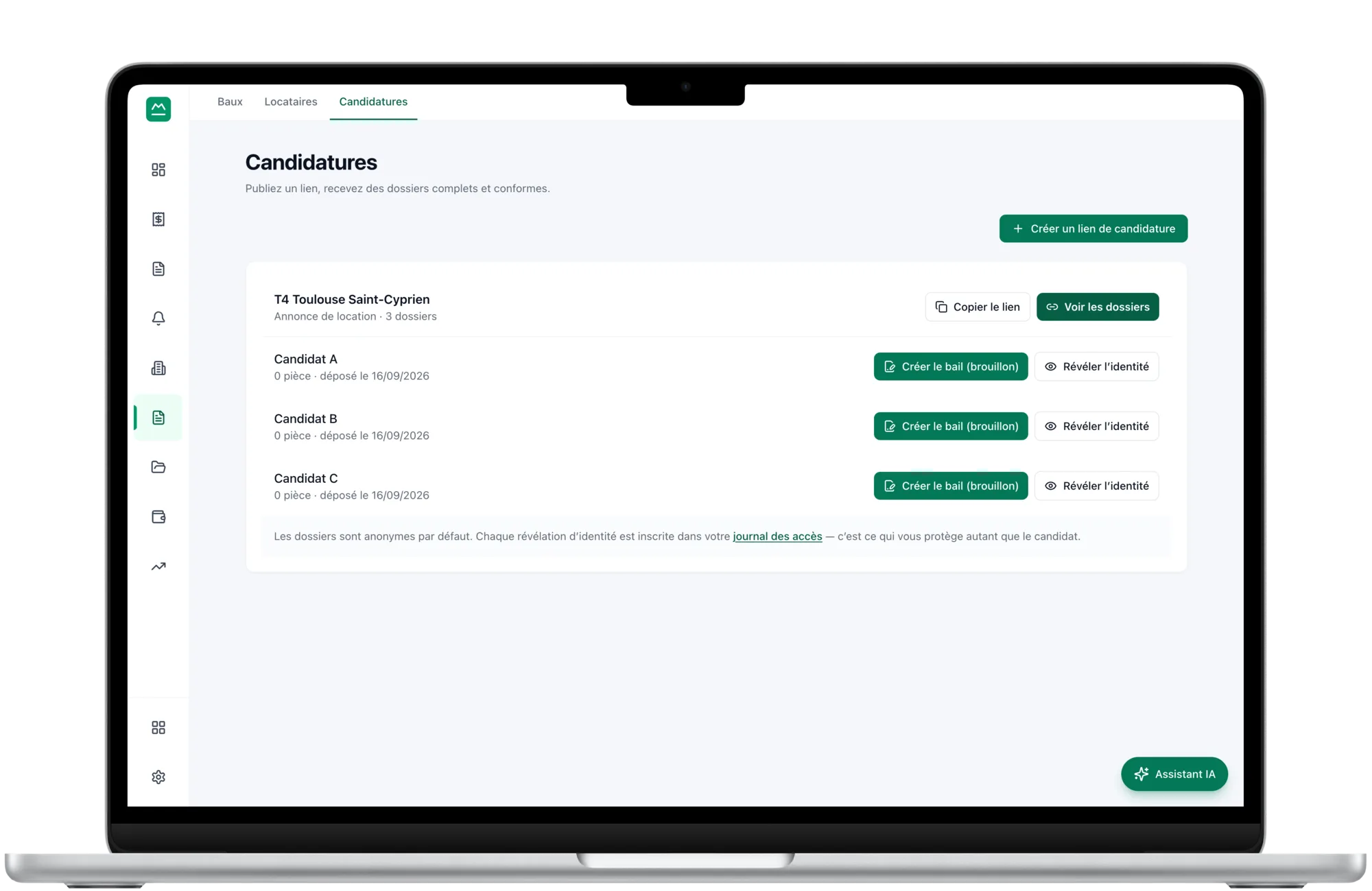
Sorting on the name is the best-documented bias in French housing. Software cannot make it impossible — but it can stop inviting it. Pilot presents the documents, hides identities by default, and logs every time you reveal one.
The list of documents you may demand from an applicant is exhaustive: anything not on it is prohibited, and the prohibition carries an administrative fine. Yet many landlords ask, in good faith, for a free-form employer’s letter, a bank statement, a criminal record extract or a holding cheque — because nobody told them the list was closed. Pilot makes the unlawful request structurally impossible: the category does not exist in the form, and a document filed outside the list is refused, with the legal reason shown to the applicant. That is more effective than a reminder in an online help page, because there is nothing to read.
It produces a public link that you share wherever you like — a listing, a message, a notice. No account for the applicant to create, no cookie placed on their browser: the link alone carries access to their file.
Identity, proof of address, proof of occupation, proof of income. Each category is the decree’s. A document filed under a category that does not exist — because it is prohibited — is refused, with the text that prohibits it.
Every document received is watermarked, and the unwatermarked original is not kept. An identity document circulating without a watermark is a document that can be used for something other than what it was supplied for.
The comparison tool shows the documents and how complete they are, not the names. So you read files before you read identities — which is all that software can usefully do on this subject.
Each document opens in a viewer, in its watermarked version, through a link that expires in five minutes. You state why you are opening it, and the opening is recorded in the log. A grid shows what is provided and verifiable in each application — a completeness grid, with no mark and no order between applicants.
When you choose to find out who applicant B is, the action is recorded in a dated access log. That does not make discrimination impossible; it makes it conscious and traceable.
Ninety days after the decision for an unsuccessful applicant, one year for the successful one. Deletion is automatic: keeping “just in case” the identity documents of people who never became your tenants is exactly what the regulations prohibit.
This is not a warning, it is an absence: the field does not exist. A form that offered the category while displaying “careful, this is prohibited” would end up being used.
Nationality, family situation, state of health, origin: none of this exists in the data model. A box you promise not to look at always ends up being looked at.
A selection file showing that the documents were examined before the identities, with a dated log, is very different from a file claiming that there was no discrimination.
It is a detail that decides the rate of complete applications. An application process that requires signing up loses the most sought-after applicants — which often means the best files.
art. 22-2 of Law No. 89-462 of 6 July 1989; Decree No. 2015-1437 of 5 November 2015
Exhaustively means that anything not listed is prohibited — including requests that seem reasonable, such as a bank statement or a certificate of no outstanding credit. The breach is punishable by an administrative fine of up to €3,000 for a natural person and €15,000 for a legal entity.
art. 1 of Law No. 2008-496 of 27 May 2008; art. 225-1 et seq. of the French Criminal Code
Faced with a substantiated allegation, it is for the landlord to show that their decision rests on objective elements. A selection that leaves no trace of method puts the landlord in the most uncomfortable position: they must prove reasoning they never documented.
art. 22 of Regulation (EU) 2016/679 (GDPR)
So we produce no applicant score, and it is not a technical limitation: a figure that decided, even partly, the refusal of a home would fall squarely within this scope. The decision must remain yours, and it must be explainable other than by a number.
art. 5.1.c and 5.1.e of the GDPR
Keeping the files of unsuccessful applicants “for next time” is retention without a purpose. It is also a concrete risk: a stock of identity documents from people who are not tenants has no reason to exist at a private landlord’s.
We do not score applicants and we do not rank them. A displayed order is a recommendation, and a recommendation on a housing application must be explainable by something other than a calculation. The decision remains entire, and it remains yours.
art. 22 of the GDPR
No nationality, no family situation, no state of health. We did not create a box while promising not to read it: we did not create it at all.
art. 1 of Law No. 2008-496
The only assessment field is a free-text note. A structured field would invite sorting, and sorting would invite a criterion — which is precisely what we refuse to provide.
Included from the Essentiel tier.
No, and it is not a technical limitation. We produce no score, no ranking and no shortlist: the GDPR gives individuals the right not to be subject to a decision based on automated processing, and refusing someone a home is exactly that kind of decision. We show you the applications; you decide.
Those in the decree of 5 November 2015, and nothing else: identity, address, occupation, income. The list is exhaustive, and asking for anything outside it exposes a private landlord to an administrative fine of €3,000. The form only offers the authorised categories.
Because showing the list of names on the first screen invites sorting on it before reading a single application. The comparison view shows “Applicant A”, “Applicant B” and their documents; revealing an identity is an explicit action, recorded in a dated log.
Yes, in a viewer, in the watermarked version and without download: the link expires in five minutes, and each opening is recorded in the log with its reason. The GDPR requires you to be able to say why you read a third party’s tax notice; the log lets you do so. The grid that accompanies the application says what is provided and verifiable — it does not mark the applicant.
No. The link you share carries access to their application: no account, no password, no cookie. That is also what makes a good application reach the end of the submission.
It is purged automatically ninety days after the decision — one year for the successful applicant, now your tenant. Keeping identity documents belonging to people who will never be your tenants is retention without a purpose.
It concerns a tenant ALREADY IN PLACE and is calculated from their payment history, their length of tenancy and the completeness of their file. It is not an applicant selection tool, and it means nothing for a file that has no history with you yet.
Unfurnished, furnished, student, mobility, seasonal, flat-share, mixed-use, garage, commercial 3/6/9 and professional, pre-filled from the property’s data — one lease per unit in a building. You never start from a blank page.
Everything filed, searchable, exportable. Each document can carry an expiry date that feeds the alerts, and the tenant finds their tenancy agreement and diagnostics in their own space.
Room by room, time-stamped photos. The check-out is compared automatically with the check-in, and the PDF is archived.
Content reviewed on 2026-10-07.
At launch: a 7-day trial on your real properties, card required.