The comparison is not left to your memory
A check-out inventory report drawn up without the check-in in front of you produces disputable deductions and omissions. Here both reports share the same structure, so the difference is mechanical.
The deposit is not withheld on an impression: it is withheld on a difference observed between two reports, both joint. Pilot has you describe the home room by room, keeps the timestamped photos, and puts the two reports side by side.
This is the rule that decides everything else. A landlord who did not carry out a check-in inventory — or carried out one so vague that it says nothing — is presumed to have handed over the home in good condition, and will have to return the deposit in full whatever the condition at departure. The presumption is not fought with memories or with undated photos. It is fought with a precise report, drawn up together, room by room, each line of which can be compared with its counterpart at check-out. Everything else in the subject — the deadlines, the deductions, the supporting documents — follows from the quality of those two documents.
The assistant moves room by room and, within each room, item by item: floors, walls, ceilings, doors and windows, equipment. Each line gets a condition level and, if needed, a written comment. What you enter is saved as you go — an inventory is done standing up, in a flat, not sitting in front of a form to be submitted in one go.
Every item can carry its photos. They are kept with their timestamp and embedded in the document produced: a photo living on a separate phone is not evidence, it is a memento.
Water, electricity and gas readings, number and type of keys handed over. These are the lines people forget when they are in a hurry, and the ones that are missing at check-out.
The same tree of rooms and items is reused, with the check-in condition in a column. You are not comparing two documents: you are reading a difference, line by line. It is this comparison that makes a deduction defensible.
The document is generated and filed in the tenancy file, next to the tenancy agreement itself and the receipts. The document is joint — drawn up together — timestamped, and sealed.
A check-out inventory report drawn up without the check-in in front of you produces disputable deductions and omissions. Here both reports share the same structure, so the difference is mechanical.
They travel with the report, which avoids the classic situation: a dispute six months later, and photos nobody can place by room or by date any more.
Every item is saved as you fill it in. An inventory is done on foot, often in thirty to forty minutes: losing what you entered at the twentieth room is the kind of incident that makes people abandon the tool.
art. 1731 of the French Civil Code; art. 3-2 of Law No. 89-462 of 6 July 1989
The presumption works against the landlord, and it also works against an inventory that is too vague: “good condition” on a single line makes it impossible to prove any damage. It is the level of detail at check-in, not the existence of the document, that protects you.
art. 3-2 of Law No. 89-462; Decree No. 2016-382 of 30 March 2016
Jointly means “together”. A report drawn up alone and then sent for approval is not joint, even if it is accurate. The tenant also has the right to have the check-in inventory completed within ten days of signing it — a period many landlords are unaware of, and exercising it changes the reference document.
art. 22 of Law No. 89-462 of 6 July 1989
The period runs from the return of the keys, and the penalty applies automatically — without any formal demand. Any deduction must also be justified by quotes or invoices: a flat-rate deduction “for restoration” does not stand.
A finger-drawn trace on a screen is not an electronic signature within the meaning of the Civil Code. So we describe the document for what it is: jointly established, time-stamped and sealed. Using the words “electronic signature” here would cast doubt on everything else we say.
art. 1367 para. 2 of the French Civil Code; Decree No. 2017-1416 of 28 September 2017
An inventory report pre-ticked as “good condition” is a document asserting something nobody has observed, and it turns against the landlord: an overly favourable check-in makes the check-out unusable.
Wear and tear, the share attributable to the tenant and the cost of repairs call for judgement and supporting documents. An automatic amount would give false assurance on the one point where challenge is the rule.
art. 22 of the Law of 6 July 1989
Included from the Essentiel tier.
No, and we do not call it that. The document is drawn up together, time-stamped and sealed — it is solid as a jointly established record. An electronic signature within the meaning of the Civil Code is a different thing, which we reserve for the tenancy agreement, and it is not open yet.
The tenant is presumed to have received the home in good condition, and you will have to return the deposit in full whatever condition is found at departure. This presumption is not fought with undated photos.
One month if the check-out matches the check-in, two months otherwise, from the handover of the keys. After that deadline, the deposit is increased by 10% of the monthly rent excluding charges for each month of delay begun, without any formal demand being required.
Yes. They can ask to complete it within ten days of signing it, and for heating elements during the first month of the heating season. The completed document becomes the reference — it is a right many landlords discover too late.
Yes, embedded in the document with their timestamp. A photo kept separately loses its link to the room and to the date — that is, what makes it evidence.
Unfurnished, furnished, student, mobility, seasonal, flat-share, mixed-use, garage, commercial 3/6/9 and professional, pre-filled from the property’s data — one lease per unit in a building. You never start from a blank page.
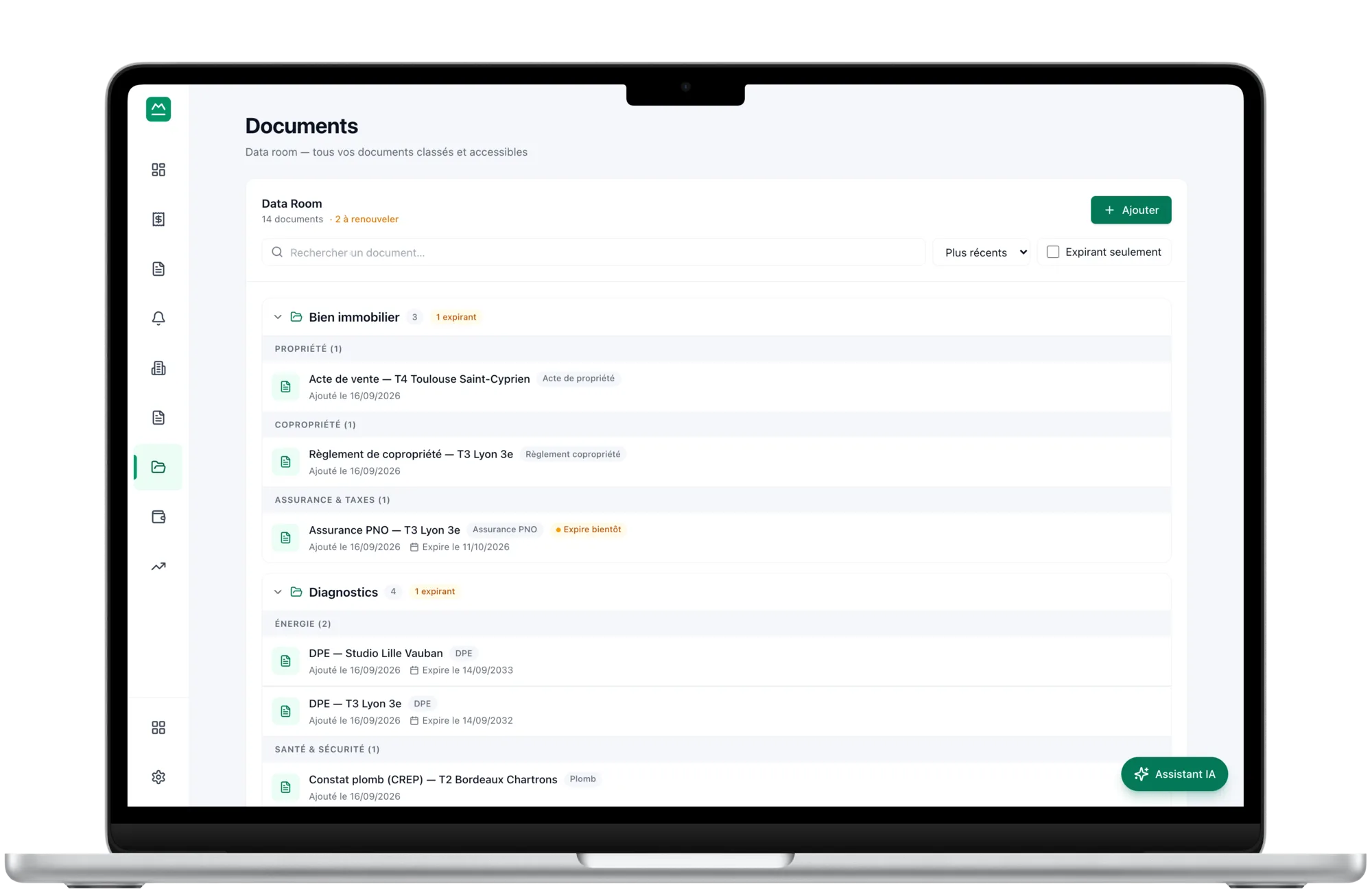
Everything filed, searchable, exportable. Each document can carry an expiry date that feeds the alerts, and the tenant finds their tenancy agreement and diagnostics in their own space.
Tenancy agreement and amendments signed remotely by both parties.
Notices to quit, formal notice, repayment plan, reconciliation, deposit refund, works, insurance, guarantor, managing agent; guarantee deed, certificates, SCI general meetings. Amounts rebuilt instalment by instalment.
Content reviewed on 2026-08-06.
At launch: a 7-day trial on your real properties, card required.