The gap between your properties becomes visible
It is almost always a surprise. The property you thought was the best is not, because you judged it on its rent and not on its total cost and its running costs.
Advice to sell is the weightiest recommendation software can give. Pilot makes it when the data allows, and refuses to make it when the data does not — saying which piece is missing.
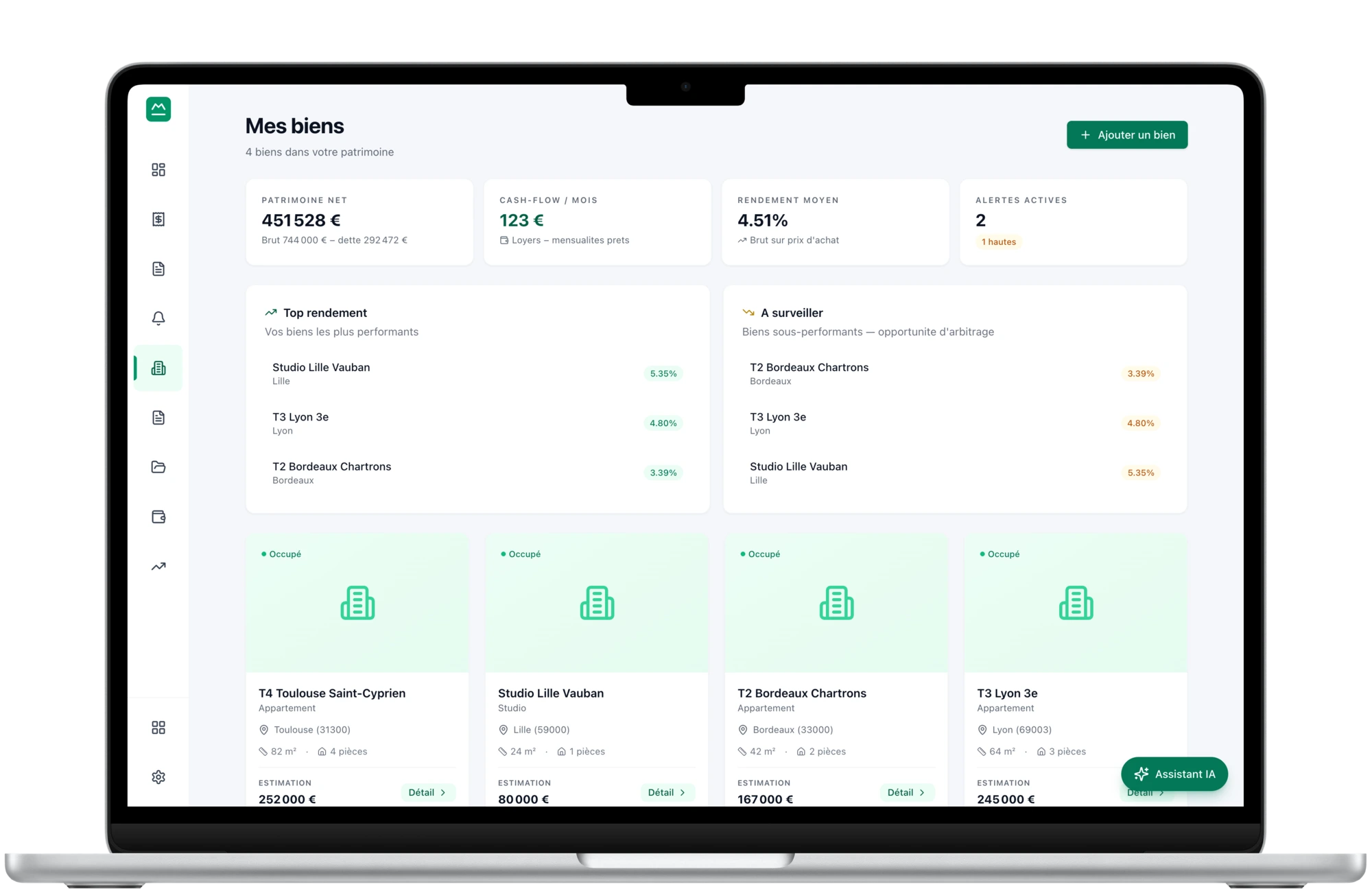
An owner of several properties almost never has a comparative view of their portfolio. Each home has its history, its tenant, its loan, and it is assessed separately — often by gut feeling. The result: you keep for ten years a unit whose net yield is half that of the others, because it has never caused a problem, and you hesitate over the one that had unpaid rent even though it performs. Portfolio decisions are not there to tell you what to do: they are there to put the properties under the same rule, with the same calculation, and make visible the gap that day-to-day management conceals.
Net yield, costs deducted, total cost as the denominator. That is the condition for a ranking that means something: two properties calculated differently cannot be compared, even if both figures are correct.
It takes in the timing of the cash flows — deposit, monthly repayments, rents, exit value — where net yield takes a snapshot of one moment. A property bought twelve years ago and one bought last year are not judged on the same indicator.
Estimated value minus outstanding loan capital, selling costs deducted. A highly valued but heavily indebted property frees up little on sale: it is this amount, and not the gross value, that should weigh in a decision to sell.
Keep, sell or watch — with the reason: yield below the rest of the portfolio, charges drifting, a regulatory constraint coming on the energy rating. A verdict without a reason is an oracle, and an oracle cannot be argued with.
If the value estimate rests on too few observed sales, no verdict is given. The reason for the suspension is displayed, and it is often actionable: completing the property’s characteristics improves the confidence of the estimate.
It is almost always a surprise. The property you thought was the best is not, because you judged it on its rent and not on its total cost and its running costs.
Recommending a sale on a badly estimated value would be the most expensive advice possible. The absence of a verdict is an answer here, not a gap.
With your spouse, your business partner, your accountant. A reasoned ranking can be challenged and improved; a score cannot be challenged, it is either accepted or ignored.
art. 1743 of the French Civil Code; art. 3 of Law No. 89-462 of 6 July 1989
So selling with the tenant in place requires no notice to quit, but narrows the market and often weighs on the price. Selling with vacant possession requires a notice to quit for sale served six months before the end of the term, with the tenant’s right of first refusal — that is, a decision to take more than six months ahead.
art. 15 II of Law No. 89-462
If the landlord then sells to a third party at a lower price, they must notify the tenant of this new price again. A decision that concludes “sell” without factoring in this timetable and this right of first refusal greatly underestimates the real time needed to exit.
art. 150 U and art. 150 VC of the French General Tax Codedisputed point
A property can be exempt from income tax and remain subject to social security contributions for several more years. So the net amount from a sale depends on the date, sometimes heavily — and it is not a parameter we calculate.
When the estimate rests on too thin a sample, the recommendation is suspended and the reason displayed. Staying silent is the only defensible answer here.
It depends on the taxable capital gain — nature of the works, what has already been deducted, length of ownership, letting regime — and on the terms of your loan. It is a calculation to be done with the documents in hand, with a professional.
art. 150 VB of the French General Tax Code
The ranking carries a readable reason, not a score. A score is compared and optimised; a reason is examined and challenged — which is what you want on a decision of this size.
Included from the Essentiel tier.
On net yield calculated the same way for every property — costs deducted, total cost as the denominator — supplemented by the internal rate of return, which factors in the timing of cash flows, and by the net value after debt and selling costs.
Because their estimated value does not rest on enough observed sales to decide. The reason is displayed, and it is often actionable: completing the property’s characteristics improves the confidence of the estimate.
No. The net result depends on the taxable capital gain, which itself depends on the nature of your works, on what has already been deducted, on how long you have held the property and on the letting regime. It is a calculation to be done with the documents in hand.
Selling with the tenant in place requires no notice to quit — the buyer takes over the tenancy — but narrows the market. Selling with vacant possession requires a notice to quit for sale served six months before the end of the term, with the tenant’s right of first refusal. It is a decision to take more than six months ahead, and the portfolio analysis flags it as such.
Costs deducted, total cost in the denominator. One single definition of yield across the whole product.
Anchored to the sales actually signed nearby, with the date of the estimate and its confidence level.
Generated from your repayment schedule, so it ages on its own. The net value follows from it, estimated selling costs deducted.
Rent below market, charges rising over twelve months, yield below the rest of the portfolio, EPC soon banned from letting, loan above market.
Compared with total cost — purchase price, fees and works — and not with the purchase price alone.
Content reviewed on 2026-08-06.
At launch: a 7-day trial on your real properties, card required.