You do not copy public data by hand
Land registry, observed prices, risks: so many searches to run on three or four sites, and to run again for every property. It is work that adds nothing for anyone when it is done by hand.
French public data is open, plentiful and practically unusable one source at a time: it lives in separate registers, in different formats, with no obvious common key. Pilot cross-references them for you from a single entry — and tells you where each figure comes from.
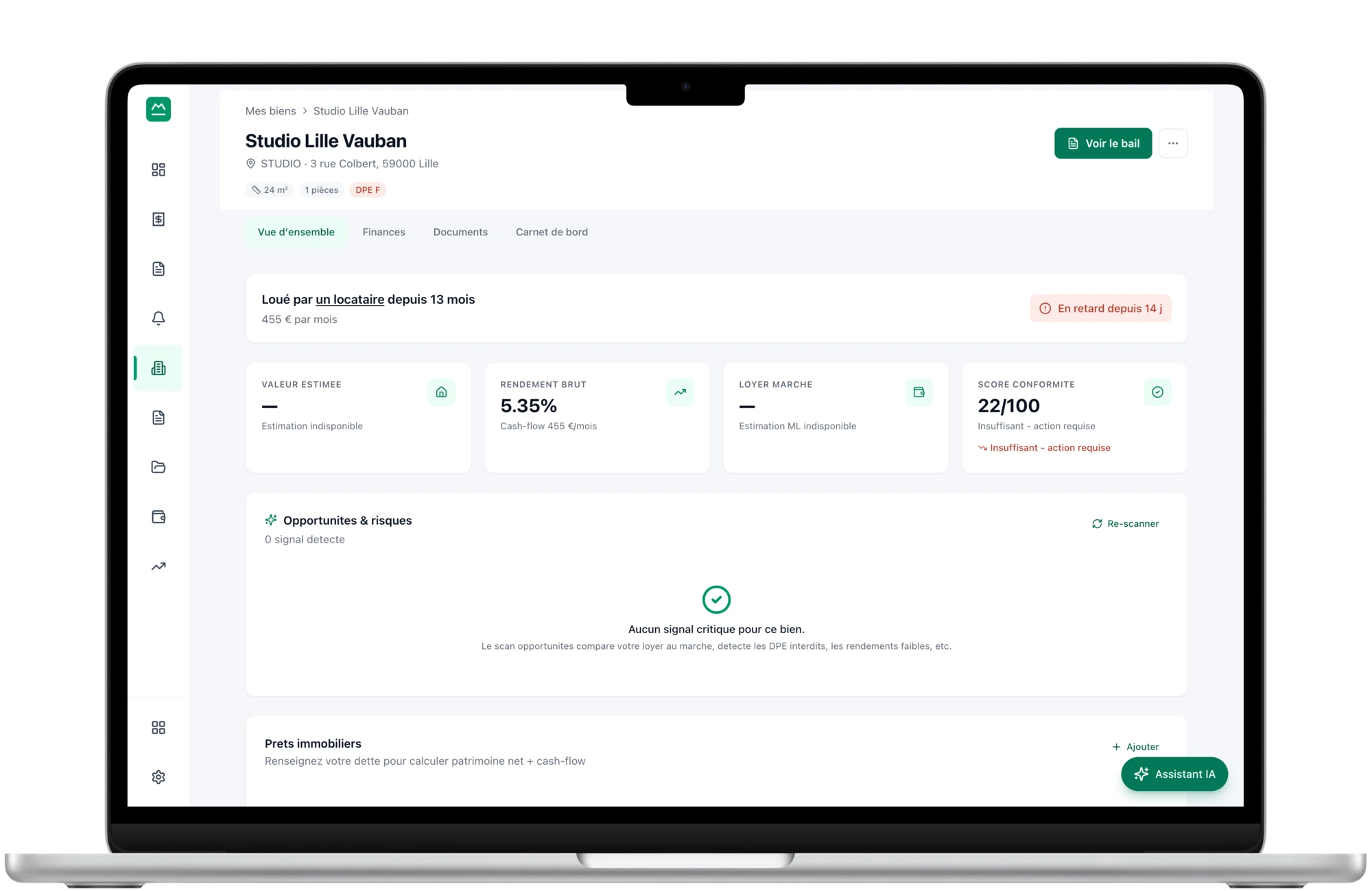
The yield, the net value, the gap to market, the arbitration verdict, the comparison between two units: everything flows from the property’s characteristics and its total cost. An approximate floor area, an unknown plot, a district price per m² copied from a listings site — and every indicator becomes an opinion presented as a calculation. Enrichment is therefore not there to impress at data entry: it is there so that decisions taken three years later rest on dated, named references, rather than on what the landlord thought they knew on the day of purchase.
Entry relies on the national address register: you do not type a free string, you choose a standardised address. That is what makes all the resolutions that follow possible.
From the location, Pilot identifies the parcel, its section, its number and its area. It is the key that then links the property to hazards and planning information.
Not listings: sales actually recorded. The difference is considerable — an asking price is a request, a signed price is a fact. The trend over several years and nearby sales are provided with it.
Flooding, ground movement, seismic activity, clay shrink-swell, installations nearby. Each risk is named and linked to the plot rather than summed up in an overall assessment — a reassuring summary is precisely what must not be produced on this subject.
With its range, its confidence level and the date of the estimate. A single figure with no range on a property is a convenient fiction; that is why we do not display one.
Actual living area, EPC and its expiry date, year of construction, purchase price, fees, works, loan terms. It is this private part that turns market references into indicators about YOUR property.
Land registry, observed prices, risks: so many searches to run on three or four sites, and to run again for every property. It is work that adds nothing for anyone when it is done by hand.
An estimate six months old is not a current estimate. Values are dated, and those that age stop triggering recommendations rather than carrying on talking.
Notary fees, agency fees and works go into the denominator of the yield and into the calculation of the change in value. Comparing a current value with the purchase price alone systematically overstates performance.
art. L. 112 A of the French Tax Procedures Code (livre des procédures fiscales); Law No. 2018-727 of 10 August 2018
Open does not mean complete or immediate: publication is half-yearly and some transactions are missing. A median price calculated on too thin a sample is not a market reference, which is why the sample size must be displayed with the figure.
art. L. 125-5 of the French Environmental Code
This obligation is an annex to the tenancy agreement, not a courtesy formality: its absence can allow the tenant to seek cancellation of the contract or a rent reduction. Knowing the plot’s risks before drafting the tenancy agreement is therefore not a nicety.
art. L. 126-26 of the French Construction and Housing Code; art. 159 of Law No. 2021-1104 of 22 August 2021
It is the private data with the heaviest consequences, and the only one public data does not give us reliably for a specific home. Entering it with its expiry date is what then lets you plan ahead — an expired EPC is usually discovered at the moment of re-letting.
These enrichments are planned and not connected: the functions exist and return an empty result. Showing them in a feature list would be exactly the kind of promise we spend our time withdrawing.
The zoning is shown when the source provides it, but we do not deliver an interpreted local planning (PLU) regulation. Between displaying a zone and asserting what can be built, there is an analysis we do not carry out.
A single price suggests a precision that does not exist for a property. When the sample is too thin to produce a defensible range, the estimate is marked as unreliable — and it stops feeding the keep-or-sell verdicts.
Included from the Essentiel tier.
The standardised address, the cadastral plot and its area, the price per m² observed on signed sales nearby with its trend, the named natural risks, a value estimate as a range with its date and confidence level, and a market rent estimate.
No, not today. The functions exist in the code and return an empty result: they are planned connections, not features. We would rather write that than let them appear in a list.
Sales actually recorded in the deeds, published in open access, not online listings. An asking price is a request; a signed price is a fact. The sample is displayed with the figure.
What public data does not know about your home: living area, EPC (energy rating) and its expiry date, year of construction, purchase price, fees, works, loan terms. That part is what turns market references into indicators about your property.
No, it is entered — with its rating, its values and its expiry date. It is the data with the heaviest consequences, since it determines the right to increase the rent and, for the lowest ratings, the right to let at all.
Anchored to the sales actually signed nearby, with the date of the estimate and its confidence level.
Cross-referenced across several sources, with its range and its sample. When the sources contradict each other, Pilot says so rather than deciding.
Everything filed, searchable, exportable. Each document can carry an expiry date that feeds the alerts, and the tenant finds their tenancy agreement and diagnostics in their own space.
EPC, surveys, insurance, end of tenancy, tax deadlines, over a rolling twelve months.
Content reviewed on 2026-08-06.
At launch: a 7-day trial on your real properties, card required.