Your properties can be compared with each other
It is the direct consequence of the single definition. Two homes bought ten years apart, with different costs, are ranked on the same basis — and that ranking means something.
The word “yield” covers at least four different calculations depending on who uses it, and the gap between the most flattering and the most honest commonly exceeds two points. Pilot keeps just one, applies it everywhere, and tells you which.
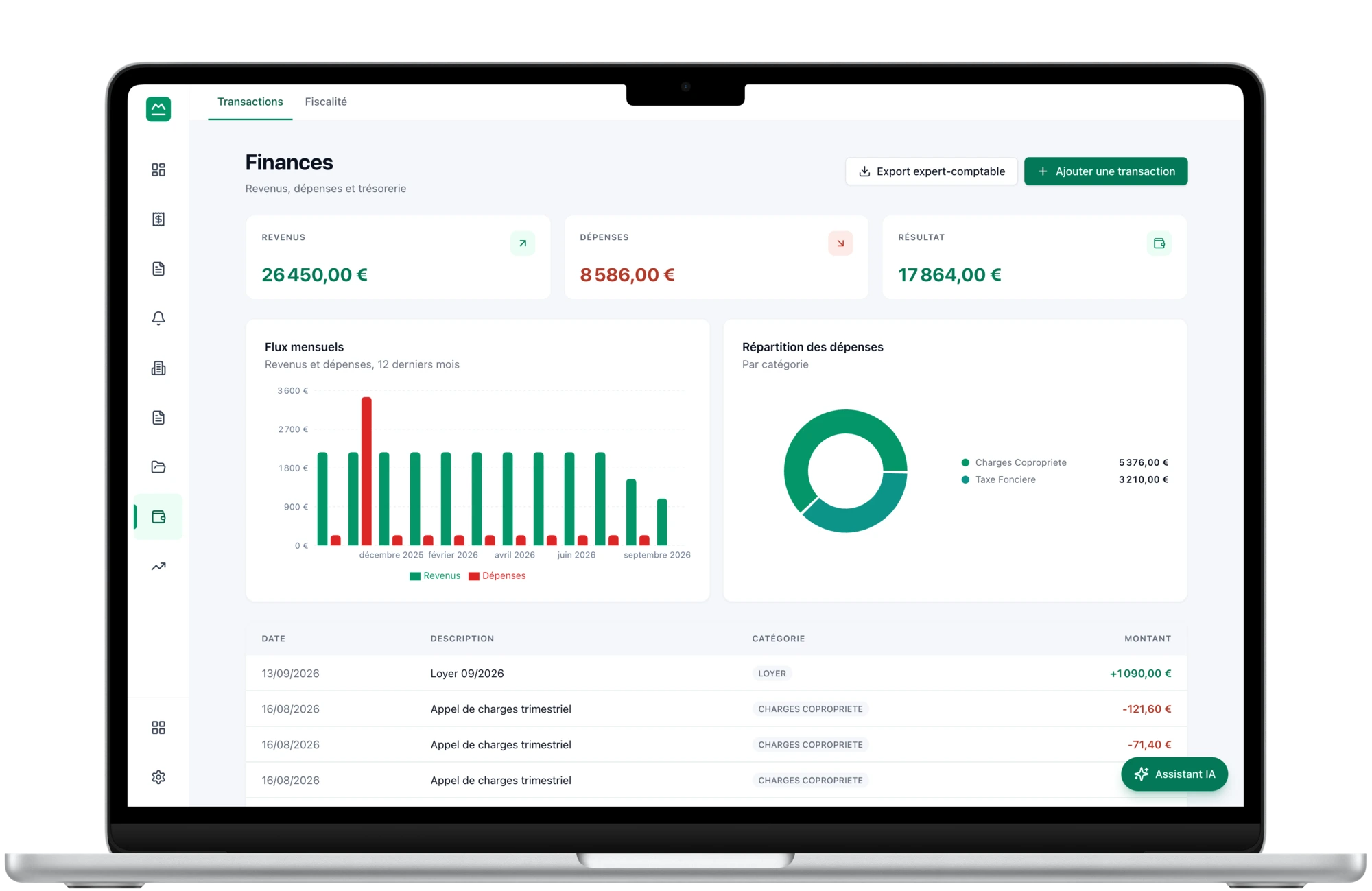
Gross yield divides the annual rent by the purchase price. Net yield deducts costs. Net-net yield deducts tax as well. And depending on whether the price paid or the real total cost goes in the denominator, the gap widens further. None of these calculations is wrong — but showing one on a property page and the other on a dashboard, without saying so, makes the whole thing unusable: the user sees two figures, does not know which to believe, and ends up believing neither. The added value is therefore not in having the best calculation, but in having just one and standing by it.
Rent actually collected over the period, not rent due. A property with two months of arrears does not have the yield of its tenancy agreement: it has the yield of its reality, and that is the one that must appear.
Property tax, non-recoverable building service charges, landlord’s insurance, management fees, maintenance. Each category of expense is identified, so you can check what goes into the calculation rather than trusting a total.
Purchase price, notary fees, agency fees, works. Dividing by the purchase price alone mechanically inflates the yield by nearly a point on an older property — it is the most common way of telling yourself a story.
Rent collected, minus costs, minus loan repayments. It is a different question from yield: a property can be profitable and cost money each month, or the reverse. Confusing the two leads to selling the wrong property.
Property file, portfolio, comparison between properties, arbitration verdict. A single figure circulates, so two screens cannot contradict each other.
It is the direct consequence of the single definition. Two homes bought ten years apart, with different costs, are ranked on the same basis — and that ranking means something.
Property tax falls in October. Over one month, it crushes the yield; over a rolling average, it takes its true place. Both views are available, and one is not presented as the other.
A property with a good yield but heavily financed can weigh on your cash flow for years. The distinction is what lets you decide with full knowledge, rather than on a single flattering indicator.
art. 14, art. 28 and art. 31 of the French General Tax Code
Not all of a landlord’s costs are tax-deductible, and not all deductible costs are recoverable from the tenant: they are three different lists. A yield calculated on the tax list is not an economic yield, and vice versa.
art. 31 I 1° b) of the French General Tax Codedisputed point
The boundary between improvement and reconstruction is a classic source of tax reassessment, and it depends not on the amount but on the nature of the works. A yield that had deducted non-deductible works would be contradicted by the tax authority, not by a spreadsheet.
art. 197 of the French General Tax Code; art. L. 136-6 of the French Social Security Code
That is why the net yield of a landlord taxed in a high bracket has almost nothing to do with that of a lightly taxed landlord, on the same property. A universal “net-net” yield does not exist: it depends on your personal situation.
It flatters by two to three points and helps no decision. The only use of gross yield is a quick comparison between listings — not managing a property you own.
It would depend on your marginal tax band, your other income and your tax household. The regime comparison handles this question separately, with your data — and not in an indicator displayed next to the rent.
art. 197 of the French General Tax Code
Even if it is more favourable, and even if it is common practice. The total cost is what you actually committed, so it is the only denominator that gives a rate comparable over time.
Included from the Essentiel tier.
Net yield: rent actually collected, costs deducted, divided by total cost — purchase price plus fees and works. The same calculation is used everywhere in the product, so that two screens cannot contradict each other.
Because it flatters by two to three points and serves no decision on a property you already own. Its real use is quick comparison between listings.
It depends on your marginal tax band and your other income: there is no universal value. The tax regime comparison handles this question separately, with your data.
Yield measures the return on the capital committed; cash flow measures what comes in and goes out each month, loan repayments included. A property can be profitable and cost you money every month. Confusing the two leads to selling the wrong property.
On a monthly view, yes, mechanically. That is why a twenty-four-month rolling average is available alongside — and why one is never presented as the other.
Costs-to-rent ratio on rents actually received, a 24-month series and a rolling average — without which October’s property tax looks like a drift.
Generated from your repayment schedule, so it ages on its own. The net value follows from it, estimated selling costs deducted.
Ranked on net yield, IRR, and a keep / sell / watch verdict — suspended when the value is not certain enough.
Micro-foncier, réel foncier, LMNP micro-BIC, LMNP réel and SCI subject to corporate tax compared side by side, then help with the 2044 return — and with the 2072-S for an SCI subject to income tax.
Compared with total cost — purchase price, fees and works — and not with the purchase price alone.
Content reviewed on 2026-08-06.
At launch: a 7-day trial on your real properties, card required.