The dates work for you
Every dated document feeds the calendar over a rolling twelve months and triggers an alert before the deadline. That is the difference between storage space and a file that warns you.
A filing cabinet does not warn you. The problem with a property file is not filing — it is that half the documents have an end date, and that date only reminds you of itself when you come to re-let or sell.
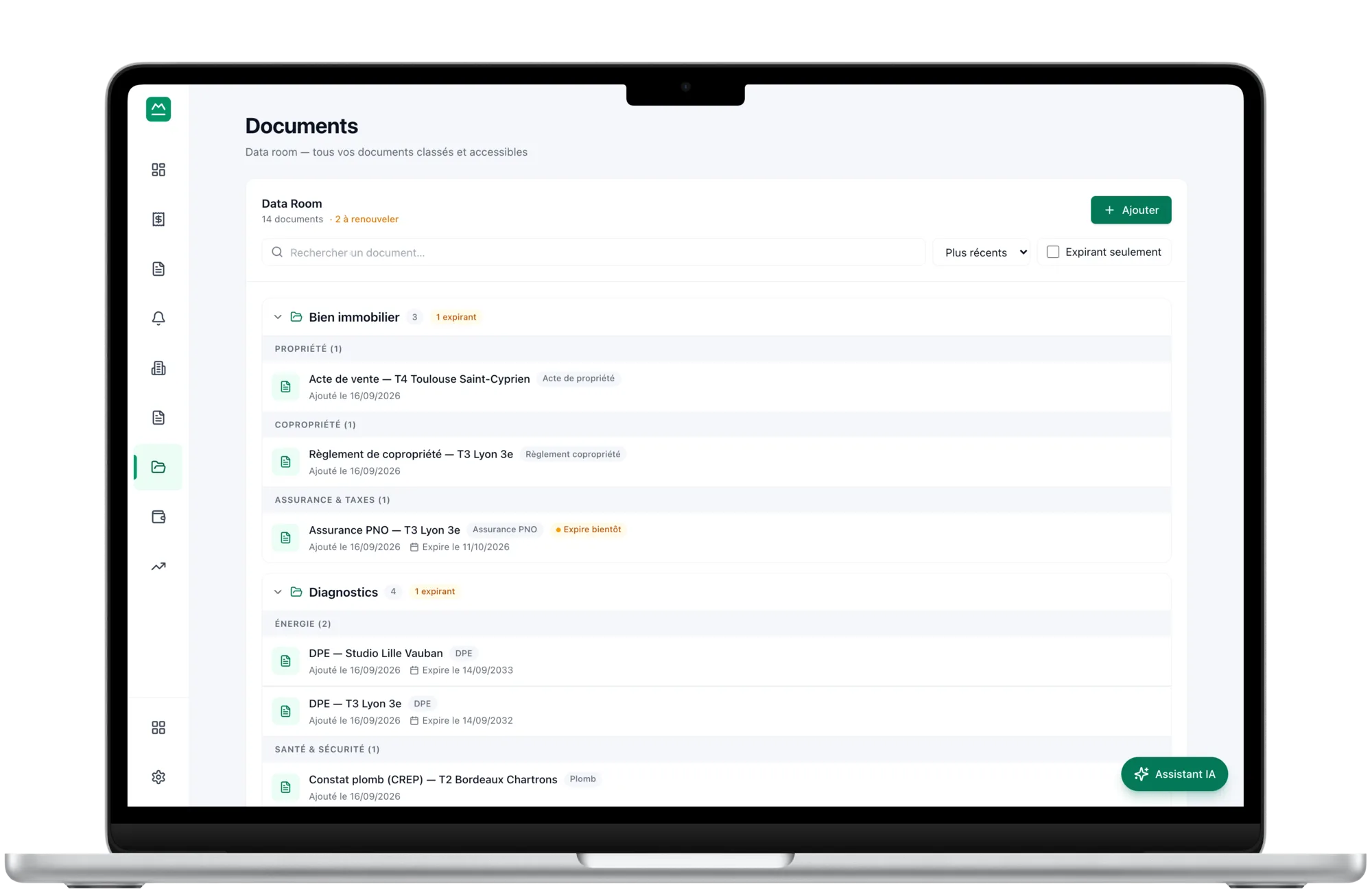
The technical survey file must be annexed to the tenancy agreement at signature. It is a short sentence hiding heavy machinery: each survey has its own period of validity, and they do not coincide. A landlord who put together a complete file on purchase finds themselves, four years later, with some documents valid and others not — without any of them looking different. The day a tenant leaves, they discover they cannot sign the next tenancy agreement until a surveyor has come back, and they lose weeks of rent. A useful data room is therefore not storage space: it is storage that knows the dates.
To the property — deed, building regulations, surveys, property tax, landlord’s insurance —, to the tenancy — signed agreement, amendments, inventory report, letters exchanged — or to the tenant. This link decides what you find again, and what follows a tenancy when it ends.
Surveys, non-occupying owner’s insurance, a tradesman’s ten-year liability cover. This date is not decorative: it is what will feed the regulatory calendar and the alerts.
Energy class, climate class, consumption and emissions values, survey number, expiry date. That is what lets you draw the consequences — the ban on reviewing the rent for the lowest classes, the ban on letting in due course.
Out of a hundred points, split between surveys, documents, insurance and legal documents. It is not a mark for good behaviour: it is a list of what is missing, presented in the order in which it will cost you most.
A link gives an accountant, a spouse or a business partner read access, with no account to create. Each viewing is recorded in a dated log — which makes the promise of confidentiality verifiable, and not merely asserted.
Deleting a document removes the database row AND the stored object. A “deleted” file that remains accessible at its address is a leak waiting to happen, and it is a very common flaw.
Every dated document feeds the calendar over a rolling twelve months and triggers an alert before the deadline. That is the difference between storage space and a file that warns you.
On the day of a sale, a rent guarantee claim or an inspection, the export exists. Rebuilding a complete file after the event always takes longer than you think, and there is always a document missing.
Read-only access, a link, and they help themselves. It also avoids sending documents by messaging apps, where they end up circulating without anyone knowing where any more.
art. 3-3 of Law No. 89-462 of 6 July 1989
Validity periods differ from one survey to another — ten years for the EPC, six years or unlimited for the lead exposure risk report depending on its result, three years for the gas installation report. A file put together in one go therefore expires piece by piece, and without warning.
art. 7 g) of Law No. 89-462
At the landlord’s request: the proof does not arrive of its own accord. A landlord who has never asked has nothing to rely on on the day of a claim, and discovers at that moment that the home was no longer covered.
art. 5.1.e and art. 32 of Regulation (EU) 2016/679 (GDPR)
A tenant’s identity documents and payslips do not need to outlive their tenancy indefinitely. And “deleted” must mean deleted: an object still reachable at its address despite its database row having gone is a breach of the security obligation.
Their space gives them their tenancy agreement, their diagnostics and their receipts — what the law owes them. Your deed of purchase, your loan, your invoices or your property tax never appear there, even through a settings mistake: it is a list of excluded types, not a switch. And a tenant never sees another tenant’s documents.
art. 3-2 and 3-3 of the law of 6 July 1989; art. 5.1.c of the GDPR
They are purged automatically after the decision. A stock of identity documents belonging to people who will never be your tenants serves no purpose, and is pure risk.
art. 5.1.e of the GDPR
Documents received with an application are watermarked on receipt, and the original does not survive. An identity document circulating without a watermark can be used for something other than what it was supplied for.
Included from the Essentiel tier.
An alert is produced in advance and the deadline appears in the calendar over a rolling twelve months. That is the point of entering the expiry date: without it, the document is stored but silent.
Yes. You are alerted thirty days before your tenant’s home insurance certificate expires, then on the expiry date. If you switch on the automation, Pilot asks them for the new certificate, then reminds them fifteen days later — and stops as soon as they upload it to their space. Formal notice remains your decision. Your own landlord insurance also has its alert, thirty days before it falls due.
Yes: the database row and the stored object are removed. A file whose reference is deleted but which remains reachable at its address is a leak waiting to happen.
Through a read-only sharing link, with no account for them to create. Each viewing is recorded in a dated log that you can consult — that is what makes the promise verifiable.
To see at a glance what is missing from a property’s file, split between surveys, documents, insurance and legal documents. It is not a mark: it is a list of gaps, in the order in which they will cost you most.
EPC, surveys, insurance, end of tenancy, tax deadlines, over a rolling twelve months.
Unfurnished, furnished, student, mobility, seasonal, flat-share, mixed-use, garage, commercial 3/6/9 and professional, pre-filled from the property’s data — one lease per unit in a building. You never start from a blank page.
Room by room, time-stamped photos. The check-out is compared automatically with the check-in, and the PDF is archived.
One public link per property. The application is submitted without an account or cookie, documents are limited to what the decree allows, and the comparison hides names. Documents are viewed watermarked, each opening traced, with a completeness grid — with no mark and no ranking.
Enter an address: land registry, DVF price per m², natural hazards and value estimate arrive on their own. No integration work on your part.
Content reviewed on 2026-08-06.
At launch: a 7-day trial on your real properties, card required.