No data to maintain
It is the main benefit, and it is invisible: there is nothing to update, so nothing to forget to update. Outstanding capital copied once a year is wrong the rest of the time.
An outstanding loan capital entered by hand is wrong the following month. Recalculated from the loan terms, it is right every day without anyone touching it — and it is what turns a property value into real net worth.
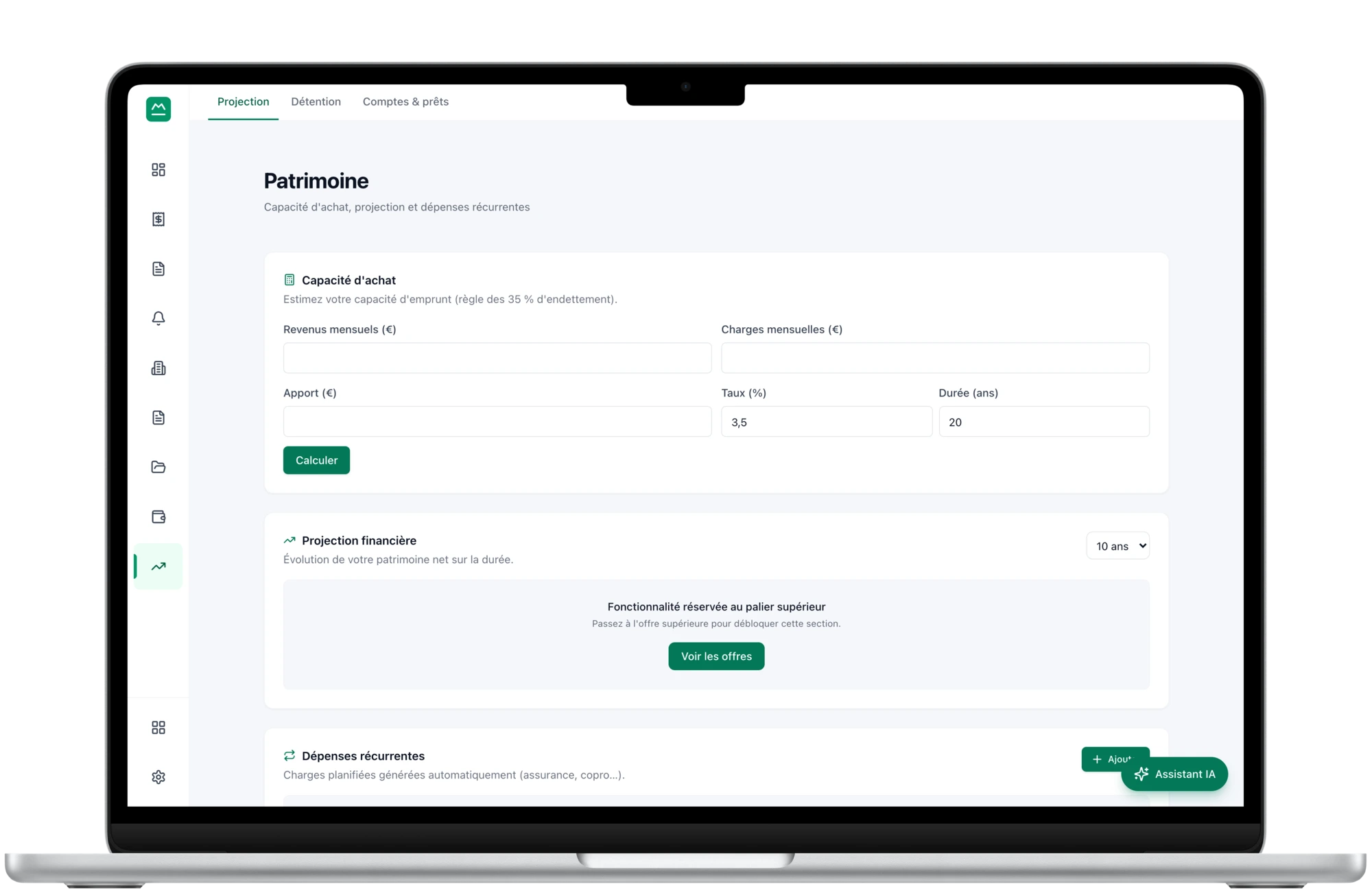
Adding up the value of three properties gives an impressive and unusable number. What counts — to choose between them, to convince a bank, to know whether a sale really frees up anything — is what remains after repaying the loan capital and paying the selling costs. Yet the outstanding capital is precisely the figure nobody keeps up to date: it changes every month, it appears on an annual statement nobody reads, and copying it into a spreadsheet means it will be wrong eleven months out of twelve. Generating it from the repayment schedule solves the problem once and for all, and that is what keeps every indicator that depends on it accurate at all times.
Amount borrowed, rate, term, date of the first instalment, any deferral. These are the figures from your loan offer — they do not change, which means there is nothing to maintain afterwards.
Interest and capital portions for each monthly instalment, over the whole term. The outstanding loan capital on a given date is no longer a figure to track down: it is a position in this schedule.
Estimated value of the property, minus outstanding loan capital, minus estimated selling costs. It is the figure that answers the question “if I sold today, what would I be left with” — and it carries the uncertainty of the value estimate, which is displayed with it.
The interest share of each instalment is deductible from rental income under the actual-expenses regime. Since it is calculated and not re-entered, it cannot diverge between your tracking and your return.
A property can carry several loans, and properties can be held in your own name, through a société civile or in joint ownership (indivision). Debts are consolidated in proportion to your shares, structure by structure.
It is the main benefit, and it is invisible: there is nothing to update, so nothing to forget to update. Outstanding capital copied once a year is wrong the rest of the time.
A bank considering new financing wants the actual outstanding loan capital and the value of the properties. Both exist, dated, with no last-minute reconstruction.
Keeping or selling is not decided on gross value: a property that has risen sharply in value but is heavily indebted frees up little. The comparison between properties is therefore made on what remains.
art. 31 I 1° d) of the French General Tax Code
It is the INTEREST that is deductible, not the monthly payment: the share of capital repaid never is. Deducting the whole monthly payment is the most common mistake in self-prepared returns, and it is immediately visible in a tax audit.
art. R. 313-25 of the French Consumer Code
The cap is a maximum, not an amount due: many contracts provide for exemptions, notably for a sale linked to a change in professional circumstances. Systematically including the maximum penalty in a resale calculation overstates the exit cost.
art. L. 314-1 et seq. of the French Consumer Code
Comparing two loans on their nominal rate tells you nothing: borrower insurance can make up a significant share of the total cost. That is why a renegotiation signal that only looked at the nominal rate would be misleading.
It recalculates it. A stored value becomes wrong from the next instalment, and nobody notices it has aged — the worst of both worlds: a precise figure that is out of date.
Only the interest is deductible. Repaying the capital never is, and a tool that deducted the whole monthly payment would manufacture a rental deficit that does not exist.
art. 31 I 1° d) of the French General Tax Code
It depends on your contract and on the reason for the sale, and many cases are exempt. Assuming the maximum would overstate the exit cost of each property, and so distort every arbitration.
Included from the Essentiel tier.
No, never. It is recalculated from the loan terms you entered once. That is precisely the point: a stored value would be wrong from the next instalment, with nothing to flag it.
Estimated value of the property, minus outstanding loan capital, minus estimated selling costs. So it carries the uncertainty of the estimate, which is displayed with it.
The interest share of each instalment is calculated and feeds the help with the return under the actual-expenses regime. Note: only interest is deductible, never the capital repaid — it is the most frequent mistake in self-prepared returns.
Yes, and debts are then consolidated by ownership structure, in proportion to your shares in a société civile or in joint ownership (indivision).
Not by default. It depends on your contract and on the reason for the sale, and many cases are exempt — notably a sale linked to a change in professional circumstances. Assuming it to be the maximum would overstate the exit cost of every property.
Anchored to the sales actually signed nearby, with the date of the estimate and its confidence level.
Costs deducted, total cost in the denominator. One single definition of yield across the whole product.
Ranked on net yield, IRR, and a keep / sell / watch verdict — suspended when the value is not certain enough.
Micro-foncier, réel foncier, LMNP micro-BIC, LMNP réel and SCI subject to corporate tax compared side by side, then help with the 2044 return — and with the 2072-S for an SCI subject to income tax.
Content reviewed on 2026-08-06.
At launch: a 7-day trial on your real properties, card required.