You keep reading them
It is the only measure of success that counts for an alert system. It is achieved by producing fewer alerts, not more.
An alert is only worth something if you read it, and you will only read it if it has never wasted your time. Pilot produces few, ranks them, and itself downgrades those that rest on data it cannot defend.
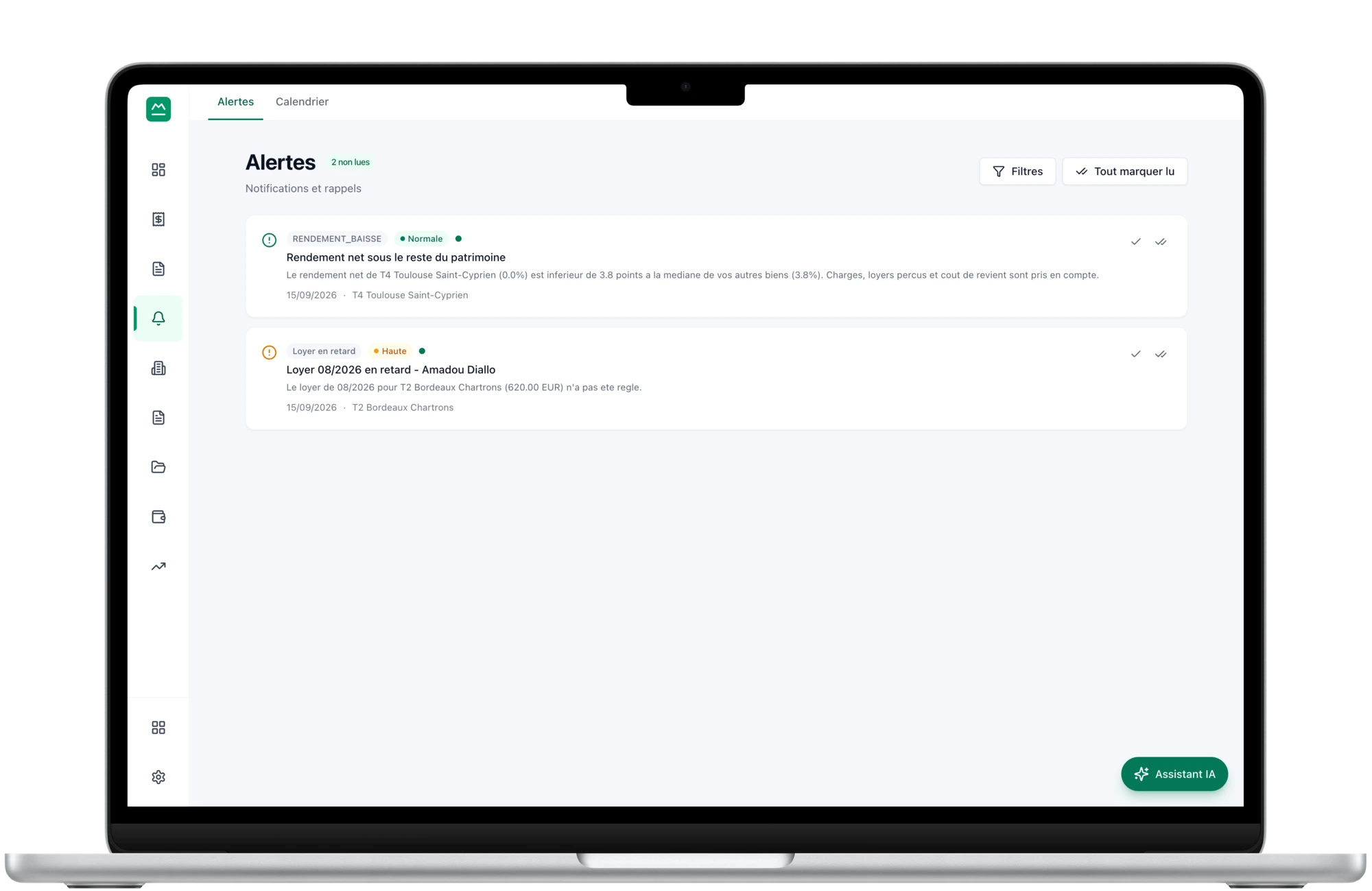
It is the central problem of any alert system, and it is solved by restraint rather than quantity. A dashboard that flags every property tax bill as a drift, every new tenant as a risk and every estimate as a selling opportunity becomes background noise within three weeks. Pilot therefore does three unusual things: it excludes from the signal what was expected, it separates what calls for an action from what is merely worth knowing, and it explicitly marks as indicative the opportunities whose calculation rests on too fragile an estimate — moving them down the list rather than presenting them like the others.
A rent clearly below the market is flagged, with the gap. But the alert also carries the constraint: where rent control applies, or where the energy rating freezes the increase, the potential displayed is capped by what the law allows — not by what the market would bear.
Two rolling twelve-month windows, which cancels out seasonality. A rise that is flagged is therefore a real rise, and not the month the property tax bill came in.
A property clearly below the others is brought to the top — with the same definition of yield for all, otherwise the comparison says nothing.
An energy performance certificate approaching a letting-ban deadline is flagged long in advance, because renovating takes months and the constraint itself falls on a fixed date.
When an opportunity relies on an unreliable value estimate, it is marked indicative and carries less weight in the ranking. It remains visible — hiding it would be another form of lying — but it does not present itself as a fact.
A credit-terms reading more than six months old stops triggering refinancing advice. Better to say nothing than to call last year’s figure “current”. The reference rate in use was read by hand on 1 April 2026 (Cafpi and Empruntis observatories): after the end of September 2026, the “loan above the market” alert stays silent until the next reading.
It is the only measure of success that counts for an alert system. It is achieved by producing fewer alerts, not more.
A “you could re-let for more” alert that ignores rent control or the freeze linked to the energy rating pushes you to break the law. Here the constraint travels with the opportunity.
An indicative opportunity remains viewable and flags its own status. That is more useful than silent filtering, which would suggest there is nothing to see.
art. 159 and art. 160 of Law No. 2021-1104 of 22 August 2021 (Climat et résilience)
These are two distinct constraints that are often confused: the rent freeze on the one hand, the ban on letting on the other, with different timetables depending on the rating. A landlord preparing for the first can be caught out by the second.
art. 6 of Law No. 89-462 of 6 July 1989; Decree No. 2002-120 of 30 January 2002
A home that does not meet decency standards exposes the landlord to suspension of housing benefit payments and allows the tenant to go to court to obtain works or a rent reduction. It is not a constraint to deal with when re-letting: it is permanent for the whole tenancy.
art. L. 121-2 of the French Consumer Code
That is why we mark our own opportunities as indicative when they rest on a fragile estimate. A gain announced in euros on the basis of an uncertain model is not a forecast, it is a claim — and it would commit us.
Property tax, scheduled service charge calls and major works already committed are excluded from the drift signal. An alert about what you knew was coming teaches you to ignore alerts.
The opportunity is marked indicative and moves down the list. We prefer a weakened, honest signal to a quantified gain that would prompt a decision.
art. L. 121-2 of the French Consumer Code
Beyond six months, the credit-conditions reading stops triggering advice. A “rates have fallen” based on last year’s data is advice that costs a bank appointment for nothing — or worse.
Included from the Essentiel tier.
Rent well below the market, charges rising over a rolling twelve months, yield below the rest of the portfolio, a survey nearing a ban date, an incomplete document file, and loan terms above the reference rate — a manual reading dated 1 April 2026, which stops being used six months later.
Because they rest on a value estimate we cannot defend — too few observed sales, an atypical property. They remain visible but carry less weight: announcing a gain in euros on an uncertain basis would be an assertion, not a forecast.
No. Property tax, scheduled service charge calls and works already committed are excluded from the drift signal. That is what allows an alert to remain credible.
Yes, and this is essential: the potential displayed is capped by what the law allows, not by what the market would bear. An alert that ignored the cap or the freeze linked to the energy rating would push you to break the law.
A weekly sweep for opportunities, a daily check for late payments and arrears. No continuous feed: an alert that arrives every day stops being an alert.
Whether a review is available or not, the date of the next one, the constraints detected with their legal grounds, and what becomes possible on re-letting. It is the distinction missing everywhere else.
Costs-to-rent ratio on rents actually received, a 24-month series and a rolling average — without which October’s property tax looks like a drift.
Ranked on net yield, IRR, and a keep / sell / watch verdict — suspended when the value is not certain enough.
EPC, surveys, insurance, end of tenancy, tax deadlines, over a rolling twelve months.
Costs deducted, total cost in the denominator. One single definition of yield across the whole product.
Content reviewed on 2026-08-06.
At launch: a 7-day trial on your real properties, card required.