You see the review before it becomes time-barred
The anniversary date and the date the right lapses appear together. That is the difference between information and a record of loss.
Rental management is not difficult: it is intermittent. Nothing for four months, then three deadlines in the same week, two of which you did not know about. A useful calendar does not list what has happened — it shows what is coming, early enough to act.
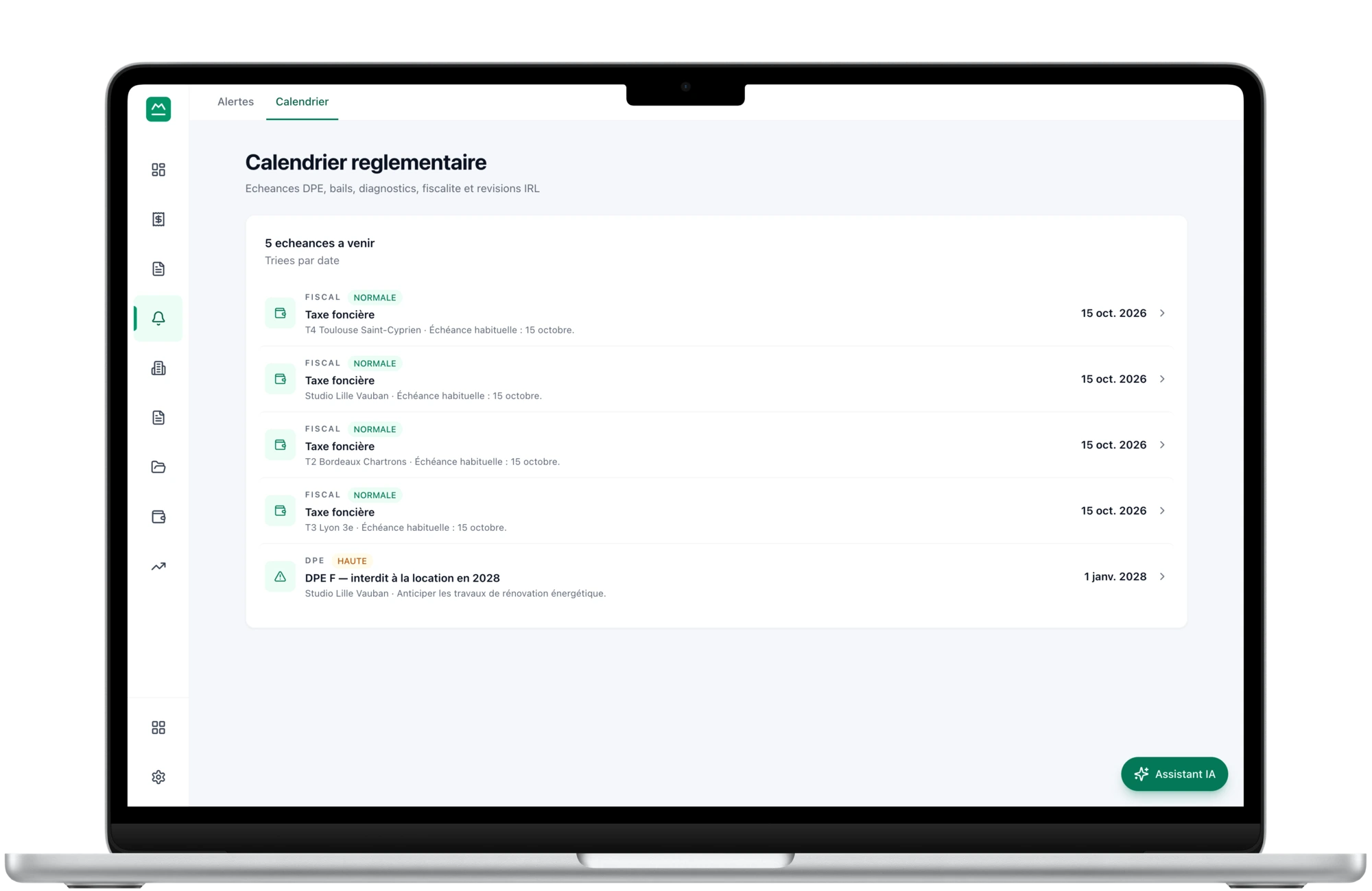
A review not requested within the year is lost. A notice to quit given too late pushes a sale back by six months. An expired survey blocks a re-letting for as long as it takes to get a professional back. An unpaid-rent claim reported after the contractual deadline is not paid out. None of these losses comes from a bad decision: they come from dates that were written nowhere, or written somewhere nobody rereads. That is why the calendar does not merely display: it sorts what requires an action, what is worth knowing and what is already done — and it never mixes the three.
You do not enter a calendar: you enter an expiry date on a survey, an end date on a tenancy, a repayment schedule on a loan. The calendar is the consequence, never an extra list to keep.
A tenancy that is ending is flagged several months in advance, because notice is counted in months. A document that expires is flagged later. A single horizon for everything would produce either constant noise or alerts too late to be of use.
An undetected rent payment requires an action; a fourteen per cent rise in charges requires reading. Confusing the two produces a task counter that never goes down — and a counter that never goes down ends up being ignored.
Record the payment, see the tenancy agreement, open the documents: the action that closes the line sits next to it. A task list that makes you hunt for the matching screen is not help, it is an index.
Receipts sent and letters dispatched in the last few days are shown in a separate lane. That is what lets you see that the product has worked, without that work looking like a task still to do.
The anniversary date and the date the right lapses appear together. That is the difference between information and a record of loss.
Every dated document flags itself before it expires, several months ahead of the regulatory horizon. Getting a surveyor back takes time, and that time is rent.
Because only what requires an action goes into it. A dashboard where everything is urgent does not inform: it teaches you to stop looking.
art. 15 I and art. 25-8 of Law No. 89-462 of 6 July 1989
The period runs from receipt, and it cannot be shortened. A landlord who discovers the deadline four months before the end of the term has lost the chance to give notice for that term: the tenancy renews, and they must wait for the next one.
art. 17-1 I of Law No. 89-462
It is the most quietly expensive date in the calendar: missing it has no visible consequence, and it is missed every year for the same reason — nothing reminds you of it.
art. 3-3 of Law No. 89-462; art. L. 126-26 of the French Construction and Housing Code for the EPC
The periods do not coincide: a file put together in one go expires piece by piece. On the day of a re-letting, there is usually one document missing, and only one — the one with the shortest validity.
A rent receipt that has gone out is not something to do. Mixing them inflates the counter with events nobody has to deal with, and the counter loses all power to alert.
Warning six months ahead for a document renewed in a week creates noise; warning one month before the end of a tenancy comes too late. Each family of deadlines has its own lead time, and they are different on purpose.
The calendar flags tax deadlines and insurance time limits; it does not file any return electronically or declare any claim. These are actions that commit you, and we have no access to your contracts.
Included from the Essentiel tier.
Rent due dates, tenancy end dates, review dates and their limitation dates, documents and surveys that expire, loan instalments and tax dates — over a rolling twelve months.
Because they require no action. A rise in charges is something to know; an undetected rent payment is something to do. A counter that adds the two together never goes down, and you stop looking at it.
It depends on the deadline: several months for the end of a tenancy, since notice is counted in months; later for a document to renew. A single horizon would produce either noise or pointless alerts.
No. It flags them. No electronic filing, no insurance claim: these are steps that commit you, and we have no access to your insurance contracts or your tax account.
Everything filed, searchable, exportable. Each document can carry an expiry date that feeds the alerts, and the tenant finds their tenancy agreement and diagnostics in their own space.
Index fetched from INSEE — IRL, or ILC, ILAT and ICC for a commercial lease — with the reference quarter taken from the LEASE. Pilot refuses to index when the law forbids it.
Three strictly sequential levels, at the interval you set. Switched off by default: it is up to you to arm them. The tenant’s home insurance and the landlord insurance have their reminders too.
Rent below market, charges rising over twelve months, yield below the rest of the portfolio, EPC soon banned from letting, loan above market.
Content reviewed on 2026-08-06.
At launch: a 7-day trial on your real properties, card required.