You stop panicking in October
And you start to see what is really moving. It is the least spectacular and most useful benefit of long-term tracking: it makes the alert credible.
A rental property’s charges are not regular: they arrive in clusters, on fixed dates, and monthly tracking gives the impression of management going off the rails four times a year. The long series is what makes it possible to tell seasonality from a real drift.
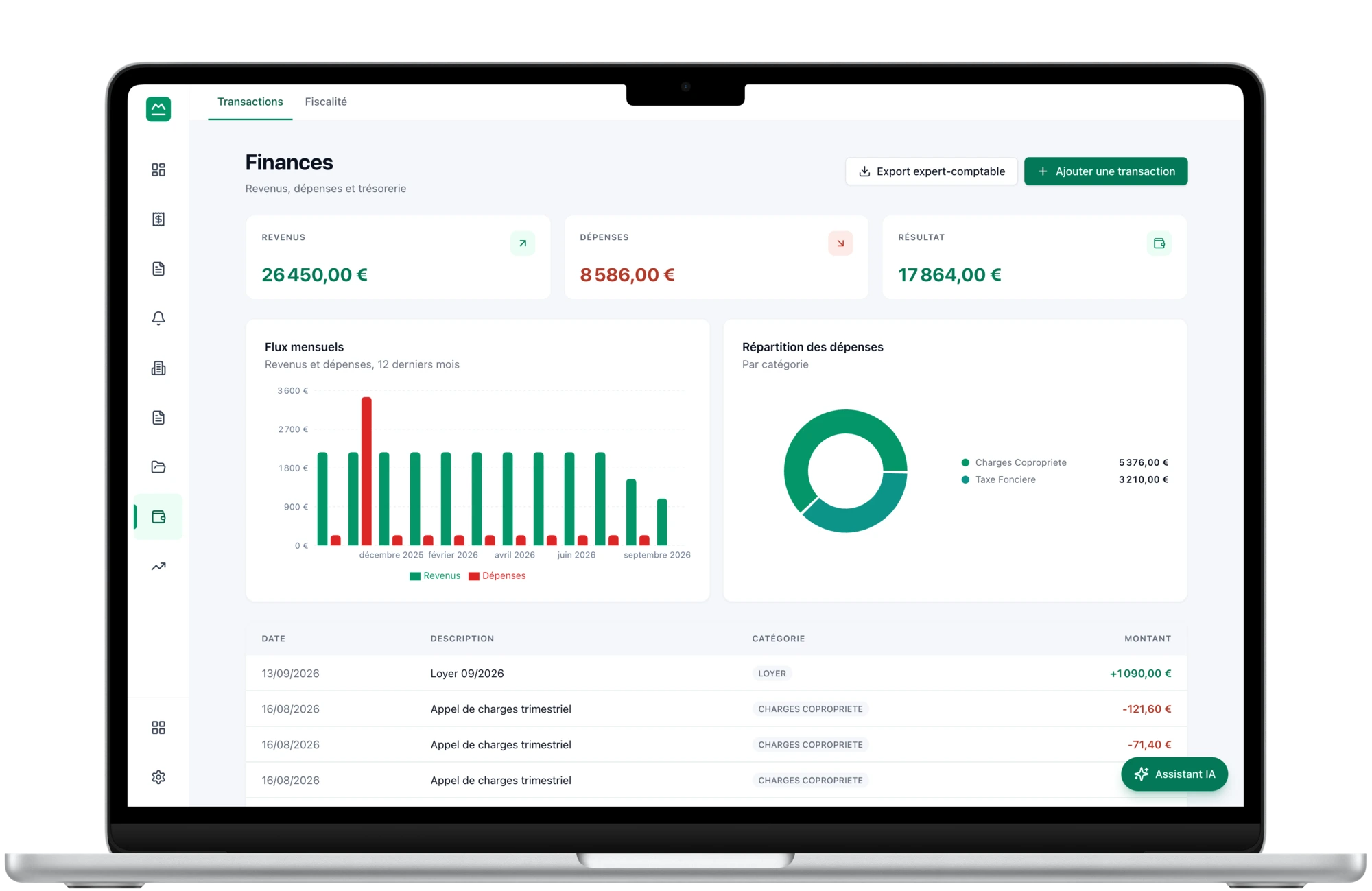
Property tax falls in October, the service charge call for the building each quarter, insurance once a year, and maintenance whenever something breaks. On a monthly chart, that produces four peaks a year that all look like a problem, and a reassuring baseline that is not one. The result is doubly unfortunate: you worry for nothing at every known deadline, and you do not notice that a charge has risen fifteen per cent over twelve months because the rise is drowned in the noise. Comparing two rolling twelve-month windows removes seasonality by construction, and leaves only what has really changed.
Property tax, building service charges, insurance, maintenance, works, management fees, bank charges, loan interest. An undifferentiated total allows no analysis: it is the breakdown that makes an increase attributable.
Not on the theoretical rents in the tenancy agreement. On a property with arrears or a vacancy, the costs-to-rent ratio genuinely worsens — and that is the deterioration you need to see, not a version smoothed by rents that were never received.
The last twelve months against the previous twelve. Each window contains exactly one property tax bill, one insurance premium, four service charge calls: seasonality cancels out, and the gap that remains is a real gap.
An expense clearly above the average for its category is brought to the top — but known and expected items, such as property tax or major works already planned, are excluded from the signal. Alerting on what you knew was coming teaches you to ignore alerts.
Insurance, service charges, subscriptions: declared once, they appear on the right dates with no re-entry. A forgotten cost is an overstated yield.
And you start to see what is really moving. It is the least spectacular and most useful benefit of long-term tracking: it makes the alert credible.
Knowing that charges rose by twelve per cent is no use; knowing that it is the building’s service charges lets you go and read the minutes of the general meeting.
Because recurring costs are recorded as entries, they cannot be left out of the calculation. A yield calculated on partial costs is always too good.
art. 23 of Law No. 89-462 of 6 July 1989; Decree No. 87-713 of 26 August 1987
So there are two categories of charges never to be mixed: those that reduce your yield for good, and those you advance before recovering them. Tracking that adds them together shows a wrong yield in one direction, and a wrong reconciliation in the other.
art. 31 of the French General Tax Code
Three lists exist — actual charges, recoverable charges, deductible charges — and they only partly overlap. The household waste collection tax is recoverable; property tax is not, but it is deductible. Confusing these lists is the most ordinary source of an incorrect tax return.
art. 18-1 of Law No. 65-557 of 10 July 1965; Decree No. 67-223 of 17 March 1967
A rise in building service charges is not a fact of life to note: it is explained in documents you are entitled to. Detecting the drift a few months before the general meeting means arriving having read them.
On rents received, always. Using theoretical rents hides exactly the situations where the ratio worsens — arrears, vacancy — that is, the ones you need to see.
Property tax, scheduled service charge calls and works already committed are excluded from the unusual-spending signal. An alert about what you were expecting trains you to stop reading alerts.
The boundary depends on the exact nature of the service. We provide the categories and the analysis; the allocation remains a choice you will have to defend before your tenant.
Decree No. 87-713 of 26 August 1987
Included from the Essentiel tier.
Because comparing two rolling twelve-month windows cancels out seasonality: each window contains exactly one property tax bill, one insurance premium, four service charge calls. What remains after this comparison is a real change.
On rents actually received. Using the rents in the tenancy agreement would smooth over precisely the situations you need to see: arrears or a vacancy genuinely worsen the costs-to-income ratio.
No. Known and expected instalments are excluded from the unusual-spending signal. Alerting on what you knew was coming is the best way to learn to ignore alerts.
No, it does not classify them for you: the line depends on the exact nature of the service, and maintaining a lift is not treated like replacing it. We provide the categories, the analysis and the breakdown.
Calculated on actual spend, with the itemisation by category and the allocation method required by law.
Costs deducted, total cost in the denominator. One single definition of yield across the whole product.
Rent below market, charges rising over twelve months, yield below the rest of the portfolio, EPC soon banned from letting, loan above market.
Content reviewed on 2026-08-06.
At launch: a 7-day trial on your real properties, card required.